It was a bittersweet day for me as an investor last fortnight.
Shares of Altium, a market leader in electronics software, rocketed up 30% on news of a takeover, after the Japanese semiconductor giant Renesas Electronics (TSE: 6723) made its move with a huge $68.50 per share cash offer.
For us, Altium is a business that we’ve long identified as an All-Star for investors interested in Satellite positions to compliment their Core holdings. It’s one we’ve covered at Rask since April 2020, going way back to Rask Invest 1.0 and a share price of $27.32.
For me, Altium is one I’ve held personally since January 2015.
With the current deal representing an eye watering ~31% gain over Altium’s all-time historical high, and a ~39% premium to its one month average, the offer is big. Very big.
If the deal goes through, it will mean a massive win for shareholders.
For me, it could lock in an incredible 2,146% return on shares bought over 9 years ago. This equates to a gravity defying 40%+ compounded return on an annual basis.
While I am sincerely thankful for the gains during this decade-long journey as a shareholder, it will sadly mark the end of the line for one of the ASX’s highest-quality businesses.
Warren Buffett famously describes his preferred holding period as forever. With huge runways for growth, and the unique ability to grow earnings by reinvesting capital and high rates of return; great businesses know it’s a marathon, not a sprint.
As long as a business can continue to tick over, and the investment thesis remains intact, for long term shareholders, like me, it’s about tucking those shares safely in the bottom drawer, and let time do the heavy lifting.
Altium is a business I was reluctant to ever sell. Why? Truly remarkable businesses are hard to find.
Let’s dig into some of the lessons learnt from an Aussie software gem that’s produced some market-thumping returns.
Altium in 2015
It was the start of 2015. You couldn’t watch Netflix in Australia yet, nor call for an Uber legally in the country. It was a time when Twitter (now X) dwarfed Instagram, and the Apple Watch didn’t even exist.
Altium was a little-known software business that was quietly kicking goals. Aram Mirkazemi had just been promoted to the CEO hot seat a year earlier, after moving through the ranks as Head of Engineering and Chief Technology Officer.
Having spent 9 years with Altium during his first stint as an engineer and code writer, it was a business he knew well, and one he had been with since the early days, even prior to its 1999 IPO. Mirkazemi was a man who had Altium in his DNA, a driving force for the business, and a forward thinking leader with a technical edge.
Altium’s core business was in decent shape too. Sales were ticking along nicely, with double-digit growth since 2012. With 47% of its revenue already recurring from subscriptions, the business had global market reach and a loyal customer base. Pricing power was evident too, with big hikes in licence fees having little effect on customer churn. This made Altium profitable, cash flow positive and a healthy dividend payer. Even way back in 2015.
With no debt and a balance sheet flush with cash after A$44.8 million of fresh capital from investors, the foundations were set for a business which had big plans to dominate the Printed Circuit Board (PCB) market.
New product launches were flagged to expand and capture both the high and low ends of the PCB market and consolidate its solid progress. This was a business with big ambition and multiple ways to win.
Riding strong industry tailwinds, Altium provided mission-critical software for key components used in electronics that we now use daily. Its software was making waves with engineers and designers, who were putting the smart in all devices that were about to get a whole lot smarter.
So just like many other small but emerging technology companies, the stage and opportunity was set for Altium.
Fast forward to a decade later and investors will find a business scorecard chocked with repeated execution and standout leadership, turning Altium’s story of potential into a commercial reality and marketplace dominance.
8 Lessons from Altium’s 2,100%+ return
1. Luck
“Luck is the flip side of risk. You cannot understand one without appreciating the other.”
Morgan Housel
I’ll be the first to admit, my early purchases of Altium and the incredible returns that come with it, are only made possible with a tremendous amount of luck. While I’m a better investor today, to call me even an amateur investor would have been a stretch in 2015.
Credit and thanks must first be put to Joe Magyer and Matt Joass, who are the two people responsible for recommending Altium during their time running The Motley Fool’s Pro service. These two gentlemen have played such a pivotal role in my development as an analyst, and it’s the knowledge and wisdom they have so unselfishly shared that has helped me become a better investor.
Without them, I would never have discovered Altium’s greatness, nor the countless other wonderful businesses they have persistently unearthed over the years.
Additionally, without skilful management and the talented team at Altium, there is no business. It’s a good reminder that as small “retail” shareholders we are typically just going along for the ride. The Altium team are the real heroes in this story. They are the ones putting in the hard yards. The real time effort and energy that is crucially needed to create and unlock vast amounts of value for this world.
From all of that we can see the role played by lady luck was vital for me to find this 21x bagger.
2. Focus on quality
With the benefit of hindsight, Altium’s track record has consistently checked the boxes needed in the quality department. In my 9 years of ownership, it delivered only a single year without growth; (and we can even give them a pass on that due to a global pandemic). Post 2014, the business never needed to raise additional capital again, despite making a host of complementary, smart and value accretive acquisitions.
Software is a capital-light business model with scaling advantages. For Altium, this meant strong and expanding profit margins, as every new user added to the platform had such tiny marginal costs you’d never notice them in the financials. The result was a powerful self-funded cash machine, snowballing free cash flow quicker than top-line sales revenue.
Add to that a successful transition from perpetual/once-off licensing to a subscription-based model meant the quality of Altium’s revenue levelled up immensely over time. Getting users to pay monthly created streams of sticky recurring revenue and dialled up switching costs. While new product tiers expanded Altium’s funnel, lowering the entry point for new users, while also capturing high value premium customers thanks to scale.
We can now see how that entire cash machine feeds on itself. It’s a thing of business beauty.
The quality thematic extends to Altium’s leadership too. With Aram Mirkazemi as CEO, and Sam Weiss as the long standing Chairman, there was real alignment. With huge amounts of skin in the game and long term corporate stability, the foundations were set for Altium to shoot for the stars.
3. BHAG – Big Hairy Audacious Goal
BHAG is a concept from one of my favourite business writers Jim Collins. In his book Built to Last, great businesses can stretch for audacious goals when armed with a clear and compelling true north.
Altium’s BHAG was strategically made public for all to see. After its first US$100 million of revenue mark was achieved, a new summit appeared, doubling to US$200 million. Before long, Altium had US$500 million in its sights and was targeting a mammoth 100,000 subscribers. These big targets only come from bold, market leading companies. For Altium it drew a line in the sand, putting competitors on notice and its team became laser focused on a common goal.
4. Businesses have seasons
Despite monster returns, Altium’s journey hasn’t been smooth sailing. Investors who expect clockwork-like performance from super-successful publicly listed companies won’t be shareholders for very long. Businesses, and growth investing, simply don’t work that way. As a young growth business, Altium needed time.
Altium needed time to transition its software from one-off licences to subscriptions. Time to launch new products to capture new markets. Time to carefully select new partners and acquire complementary businesses. Time to bring its software to the cloud.
Executing successfully on these would mean Altium could break into new markets, add new lines of revenue and arm it with multiple ways to win.
But while time is constant, business performance certainly isn’t. Boom years like 2018, 2019 and 2022 produced +20% growth for Altium, while 2020 and 2021 were tough; where sales briefly saw red, and growth regressed back to single digits. The share price often acted swiftly negative as uncertainty emerged. I’m sure many investors, seeing red in their portfolio that day, said to themselves, “is this the end of Altium’s great run?”
The thing is, these swings are normal, in business and in life.
Investors need to make peace with the fact that businesses aren’t robots. Performance and results won’t be linear.
Instead, the key here is consistency and direction of results. It’s about seeing how great businesses react after setbacks and failures.
6. Valuation / multiple expansion
Over the years, the common Altium bear case from investors and professional fund managers went something like: “great business… but too expensive”.
Even when I first bought shares in 2015, Altium was trading at ~24x earnings (i.e. a P/E ratio of 24x). Certainly not what a ‘value investor’ would call cheap. This meant high expectations for growth, and the business needed to keep delivering well into the future.
This doesn’t mean all businesses trading at high P/E multiples equal ‘good quality’.
Nor that investors can blindly buy all businesses trading at lofty multiples.
It does, however, give opportunities for immense wealth to be created for those that can successfully decipher the signal from market noise.
Understanding why certain businesses warrant expensive valuations can give shrewd long-term investors the conviction needed when paying up for quality. Just keep in mind, a company needs to meet many criteria before the real conviction comes.
Guarding against All-Star-Pretenders whose share prices are simply leveraging hype and momentum (e.g. “AI stocks”), will mean protection against the invariable value destruction when reality sets in, and the failure to deliver on unachievable expectations from sky high valuations built like a house of cards.
Quality businesses also arm investors with a secondary engine of growth. While business fundamentals and free cash flow production are primarily drivers for long term value creation, business quality can unlock multiple expansion and supercharge returns.
With Altium’s ability to continuously execute, its reputation in the industry grew as it displayed a rare ability to self-fund its growth year after year. This meant Altium shares soon became scarce.
With shareholders not wanting to sell, and a growing list of buyers, the profit multiple which shares have changed hands at, exploded.
Just ask yourself: When maybe only 10-20 Aussie companies have truly proven themselves, are growing into a huge global market, and they are doing it profitably, it makes sense it’ll have a much higher valuation, right?
While predicting valuation expansion isn’t something investors should bank on, quality businesses have an uncanny way of leveraging this secondary engine of growth beyond simply increasing profits.
7. Patience and holding on
“The stock market is a device for transferring money from the impatient to the patient.”
Warren Buffett
It’s not easy to hang onto big winners.
I would know, having sold the likes of Apple, Meta, Afterpay, Wisetech, Xero and countless others far, far too early.
It’s particularly hard when shares are flying. The temptation to lock in profits when capital gains appear is ever-present. Investing in big winners mean you’re constantly fighting the urge to sell, particularly when you’re already looking for the next market darling.
Harder still is having the stomach to hold on when Mr. Market’s mood inevitably changes… for the worse.
The chart below shows how many times Altium shares were crushed, falling from their previous peak, during my nine years of ownership. On eight occasions the stock fell around 30% from the previous high. On three occasions it fell over 40%!
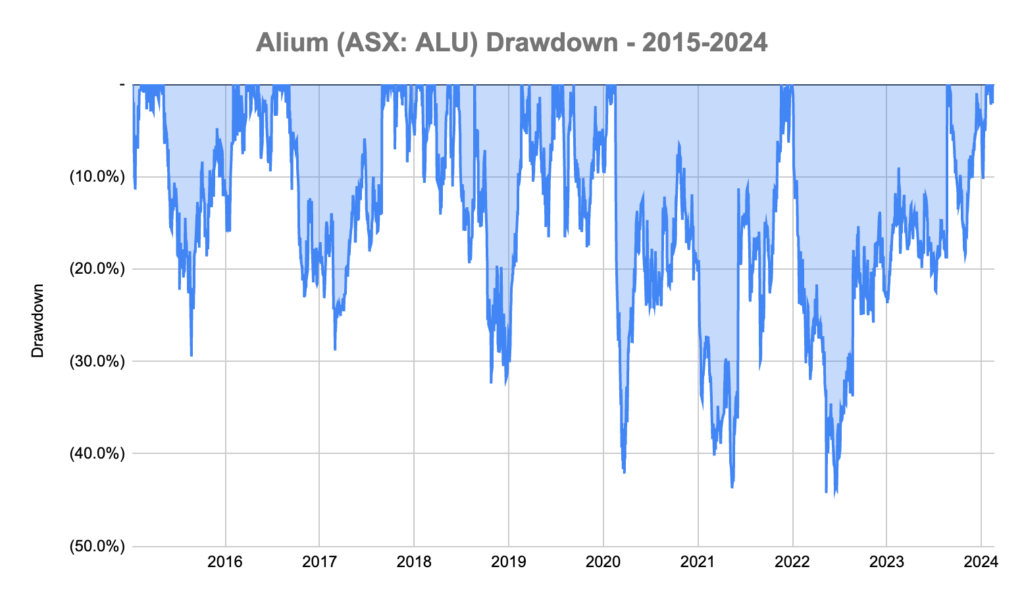
These stomach wrenching drops mean shares needed to claw back +42% and +67% of returns, just to get back into the green.
This is the real test of growth investing.
Even for the most seasoned professional investor, market noise can be deafening at times. But for those few who have been able to ignore the false sirens and stand tall in the jaws of fear, patience has rewarded brave shareholders handsomely.
8. Waiting for the fat pitch
The flipside of the drawdown chart also highlights the pockets of opportunity valiant investors had to buy a great business like Altium. When market sentiment changes, even the best businesses are thrown out with the bathwater, and fall quickly out of favour. This has been core to Buffett’s strategy at Berkshire Hathaway.
Maybe it’s a period of missed earnings. A temporary drop-off in a key geography. A slower than anticipated launch of a new product. Or the sell down could be macroeconomic (e.g. rising interest rates, Covid shutdowns, etc.).
Identifying when these setbacks are temporary, against events that are fatal and thesis breaking, will give patient investors ‘golden tickets’ to great businesses. The key, however, is you need to be ready, having done your research before the drop, as these windows don’t stay open for long. And it’s your research, completed in advance, that lets you decipher market ‘noise’ from ‘signal’ during the selloff.
Final thoughts
Altium is one of our favourite investment stories here at Rask. While there’s still some water to go under the bridge before any deal is properly locked away, Altium has certainly earned its title as a Rask All Star. Cementing its deserving position as one of the highest quality businesses listed on the ASX.
More importantly, Altium’s journey shows what can be achieved when a great business executes with consistency, and unlocks immense value for its customers and shareholders. Throw in a brilliant management team and you’ve got all the makings of a market thumping multibagger.
On behalf of all long term shareholders at Altium, we thank you for an incredible ride.
Here’s to finding the next one…