
Firstly, Merry Christmas and Happy New Year to you 🎅. If today is the last time you tune in for Rask Core updates, I wish you all the best for the break (if you have one) and hope you find time to put your feet up and relax, if only for a few hours.
I haven’t taken more than one full week off since 2017, so the Rask team and I are taking a break for the next few weeks. Rest assured, I’ll still be monitoring portfolios and checking emails, but we won’t be as responsive as usual. Also, we’ll be running Summer Series ☀️ on both The Australian Investors Podcast and The Australian Finance Podcast. There will also be some episodes on The Australian Business Podcast.
In short, some of our best insights ever will air over January — please tell your friends and family at Christmas to check it out (Finance Pod = beginner/intermediate; Investors Pod = intermediate/advanced).
Now, let’s get onto the meat inside this end-of-year update…
Sell: HBRD; trim: AAA; buy: VBND, SUBD & add more IAF
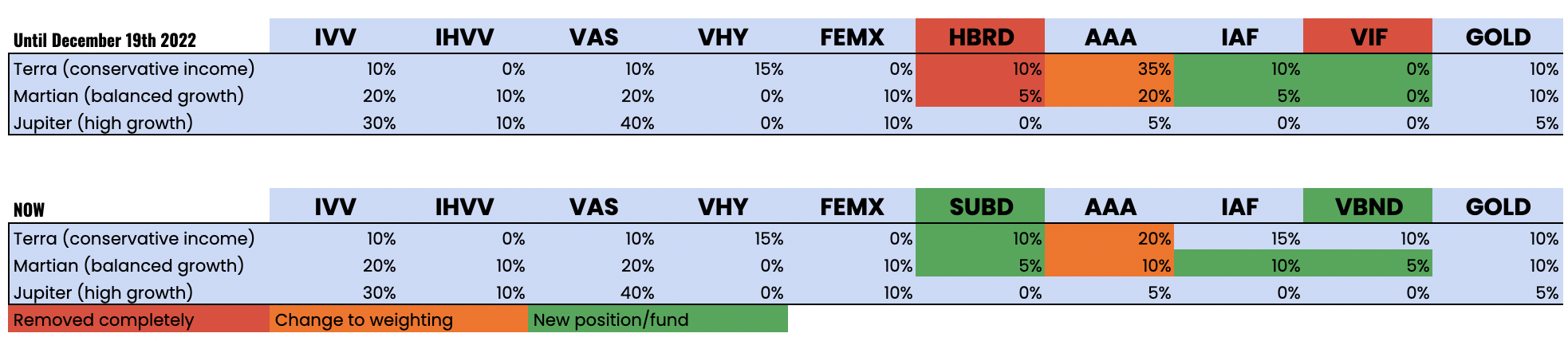
Today, I’m announcing the first major change to Rask Core portfolios.
Remember, unlike, say, a Vanguard ‘pre-built’ portfolio (VDHG, VDBA, etc.), which can often follow a ‘dumb’ set of rules, we use our research and networks of researchers to design slightly more active portfolios than what you ‘get out of the box’ with Vanguard.
For example, if you simply avoided investing in Government bonds over the past 3 years (which are included in all Vanguard portfolios) you might have generated an extra 1-3% per year — depending on your allocation — with lower fees. We told Rask ETF members to sell out of Government bonds a couple of years back.
Right now, I’m making a decision for Rask Core portfolios to get more exposure to falling interest rates by investing in bonds.
Yes, you read that right. Falling interest rates.
Remember that the two big financial markets (stocks and bonds) are forward-looking. Most investors look forward 1-2 years to make better decisions today.
Falling interest rates is something Drew Meredith and I have been talking about almost religiously in 2023 and 2024, on The Australian Investors Podcast’s 2 Sense episodes — every Saturday morning, 7 am.
For the record, I could be wrong. Or early. On my call.
I suspect interest rates in Australia and the USA could go up a little bit more before they come down.
However, even if I get it wrong — and interest rates go up more than I roughly expect — we would still be moving our money into a traditionally very safe asset class: Government bonds. Government bonds are one of the safest asset classes in the world because Governments can effectively print more money to control their economy. And if a Government can’t pay its own mortgage… well… we’ll have bigger problems to sort out.
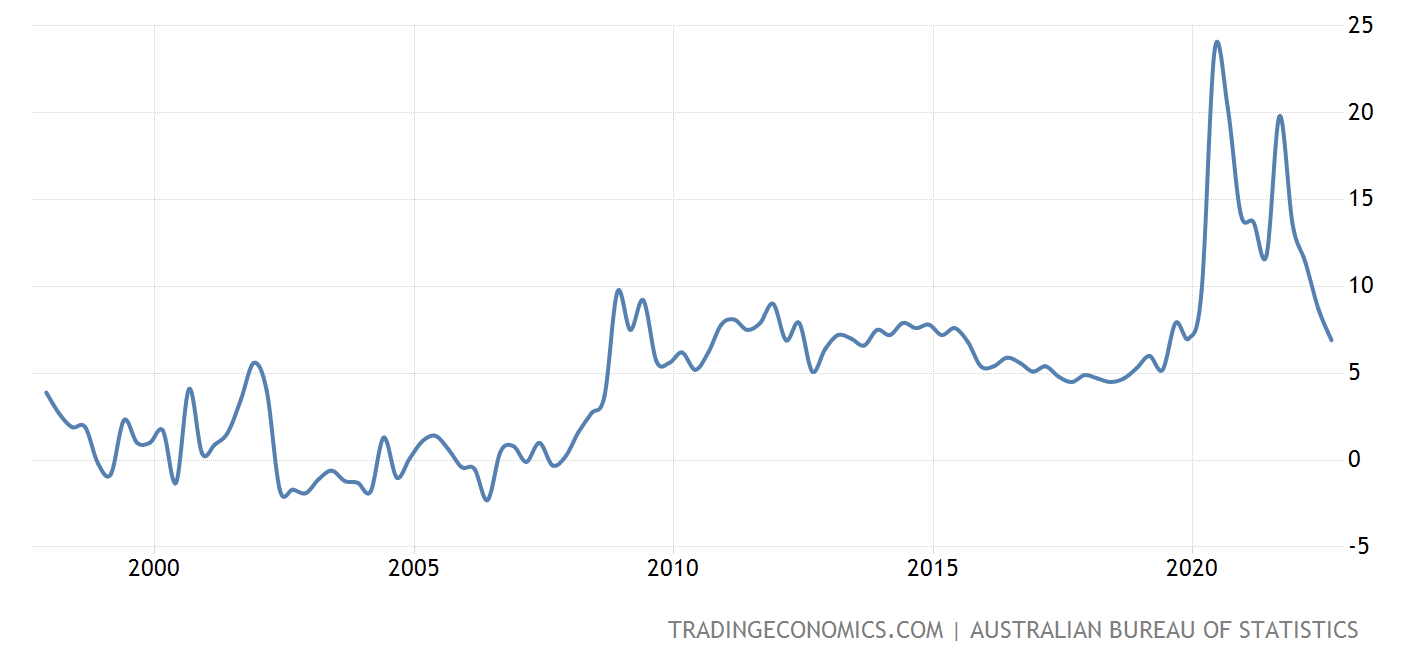
Let’s take stock of what I believe is going on in the world:
- Higher interest rates are already starting to bite down hard on the wealth of households. Property is down, tech stocks are down, most Crypto should soon disappear, etc.
- Corporate employers seem to be leaning towards layoffs versus hiring for the first time in a long while.
- US interest rates might need to go higher before falling, given their interest rates for things like mortgages are often locked in for years in advance (unless like).
- Inflation seems to be slowing.
- Household savings are falling quickly, which I suspect could directly impact confidence and spending after Christmas.
In short, the worst of interest rate rises we’ve already done is yet to be felt. An extra $1,000 on a mortgage for one month might be manageable, but 12 months? We’re well on our way to slowing down the economy.
Why do I want exposure to falling interest rates (Government bonds)?
Falling interest rates mean a few things for Aussies:
- Term deposit rates will begin to fall (we’re already seeing some banks lowering their rates on three or four-year term deposits). If you have extra cash, you might consider using a few good term deposits to lock in your interest rate.
- Increases in mortgage interest rates should slow down. Maybe not straight away, but interest rates won’t go up forever. In Australia, we’re facing a ‘mortgage interest rate cliff‘. This is when a huge number of homeowners will face going from lower fixed rates on their mortgage to much higher variable rates. This will hit many Aussies harder than a cricket ball delivered by Pat Cummins. The Reserve Bank knows this is coming.
- Existing Aussie Government bond ETFs (“long duration”) will go up in price.
Point #3 is the key thing for us.
When the official interest rates set by the Reserve Bank of Australia (RBA) are expected to fall — it pushes up Aussie Government bond ETFs.
Why?
Imagine you buy a 10-year bond paying 4% per year today. Then imagine interest rates on new bonds fall to 2% tomorrow. It’s the same bond, but one is paying twice as much in interest.
Is your bond (at 4% interest) worth more, or less, than the same bond paying 2%? The answer: lots more.
This is why existing bonds, at higher interest rates, are worth more when interest rates fall. And it’s why I’m taking a probabilistic view for Rask Core members in saying that, over the next 2 years, we should slowly start moving our money back into long-dated (“long duration”) Government bonds.
In addition to the bond ETFs potentially going up in share price, investors should begin to receive better coupon payments, the bond equivalent of share dividends, since the new bonds (paying more coupon) slowly make their way into the ETF portfolio.
What are the changes?
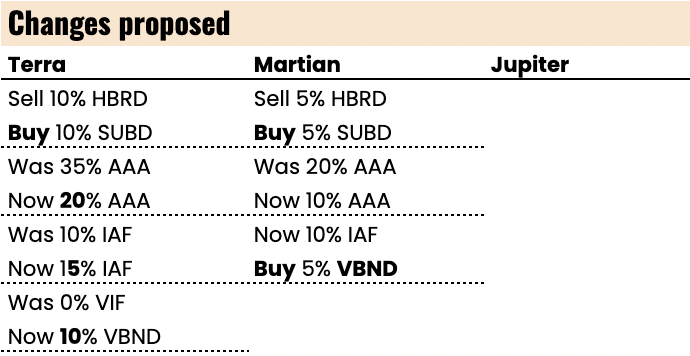
Changes to our Terra portfolio (conservative income)
I’m recommending Terra portfolio investors fully exit their position in the Betashares Hybrid Securities Fund (ASX: HBRD) and swap it directly with VanEck’s Subordinated Debt ETF (ASX: SUBD). SUBD has lower fees than HBRD but most importantly, it invests at a higher grade of debt — which is also more easily traded by the ETF provider (VanEck). I hold a reasonably strong concern that the HBRD fund from BetaShares may suffer meaningfully poor performance when investors stop adding money to the fund itself. Why? Because the hybrids are quite illiquid — making it hard to buy and sell more hybrid securities as the fund gets larger. Thus, if the HBRD fund stops buying hybrids we could see the prices of said hybrids artificially falling (for no other reason than a big fund isn’t buying). Crucially, the SUBD ETF has a better credit risk profile than HBRD and lower fees — but SUBD still yields a high amount of interest (~4.93% versus 5.8%, as of mid December). The SUBD PDS is available on this page. Information on HBRD is here. Please consider the risks and read the PDS before investing in anything.
In-line with my decision to move more of the portfolios towards interest-rate benefitting assets, I’m increasing Terra’s exposure to Aussie bonds (IAF) to 15% of the portfolio (from 10%) and adding global bonds (the VBND ETF) to 10%. This money comes from the cash ETF (AAA). AAA offers a decent yield but, much like a term deposit, won’t benefit if interest rates drop. VBND is the Vanguard Global Bond ETF (hedged) (ASX: VBND), providing a decent yield of ~2.28% with more focus on the USA than the alternative VIF ETF (which invests heavily in Japan). You will find more information on VBND here, including the PDS.
All things considered, we’re really just improving the risk profile of the portfolio (via SUBD, which captures floating rate bonds) and the exposure to Government bonds (via VBND and IAF).
Changes to our Martian portfolio (balanced growth)
I’m recommending Martian portfolio investors exit their position in the Betashares Hybrid Securites Fund (ASX: HBRD) and swap it directly with VanEck’s Subordinated Debt ETF (ASX: SUBD), as above. The SUBD PDS is available on this page. Information on HBRD is here.
Also as above, I’m recommending an increased exposure in the portfolio to IAF (Aussie bonds) and VBND (global bonds).
💡 Note: there’s a chance I may sell the SUBD exposure in favour of all Government bonds, in time. But for now, having some exposure to floating rate bonds inside SUBD makes sense to me.
There is no change to the Jupiter (90/10) portfolio.
Summary and risks of this move
Please know that there’s a risk I get this wrong and moving to Government bonds now is a mistake. In investing, it can be hard to know if we’re wrong — or if we’re just early. Sometimes there is no difference.
For example, let’s imagine inflation persists and drives interest rates higher and higher in 2023. We would lose out because by focusing on long-dated (“long duration”) bond positions, we could have waited and got a better deal on our bond ETFs. The thing is, just look around the economy, I doubt that our economy can sustain much more meaningful interest rate increases without seriously impacting employment levels, GDP/economic growth and businesses.
I believe many Aussies (and US citizens) will feel the pinch of higher rates, layoffs and uncertainty, beginning in 2023. This, eventually, should put lots of pressure on the Government and central banks (RBA, US Fed, etc.) to stimulate their economies by at least maintaining interest rates or by lowering them.
If we start to tweak the Rask Core portfolios towards Government bonds now we stand to benefit from higher interest rates on our bonds and may even get a free kick from higher bond prices.
I welcome your feedback in the Rask Core community.
Cheers!
Owen
P.S. since The Rask Group Pty Ltd’s ETF portfolio follows the Jupiter Rask Core model portfolio, there will be no change to our ETF holdings.
WARNING: Always consider the risks and speak with your financial adviser before acting on this general information. Rask Core provides generalised financial advice only. Nothing on our websites has been tailored to your financial needs, goals, objectives or tax position. Always read the Product Disclosure Statement (PDS) of any ETF before you invest, and remember past performance is not indicative of future performance.