
Recently, I recorded a live session on 5 companies with strong competitive advantages for Selfwealth Live. Afterwards, it occurred to me I haven’t yet gone into why “moats” are important to me as an investor.
Fast-forward to 8:45 into the video for my talk about moats.
The following write-up is a direct copy of something I wrote to Rask Invest members in 2020.
***
As you know, here at Rask, one of the key pillars in our investment philosophy is investing in companies with strong advantages or moats.
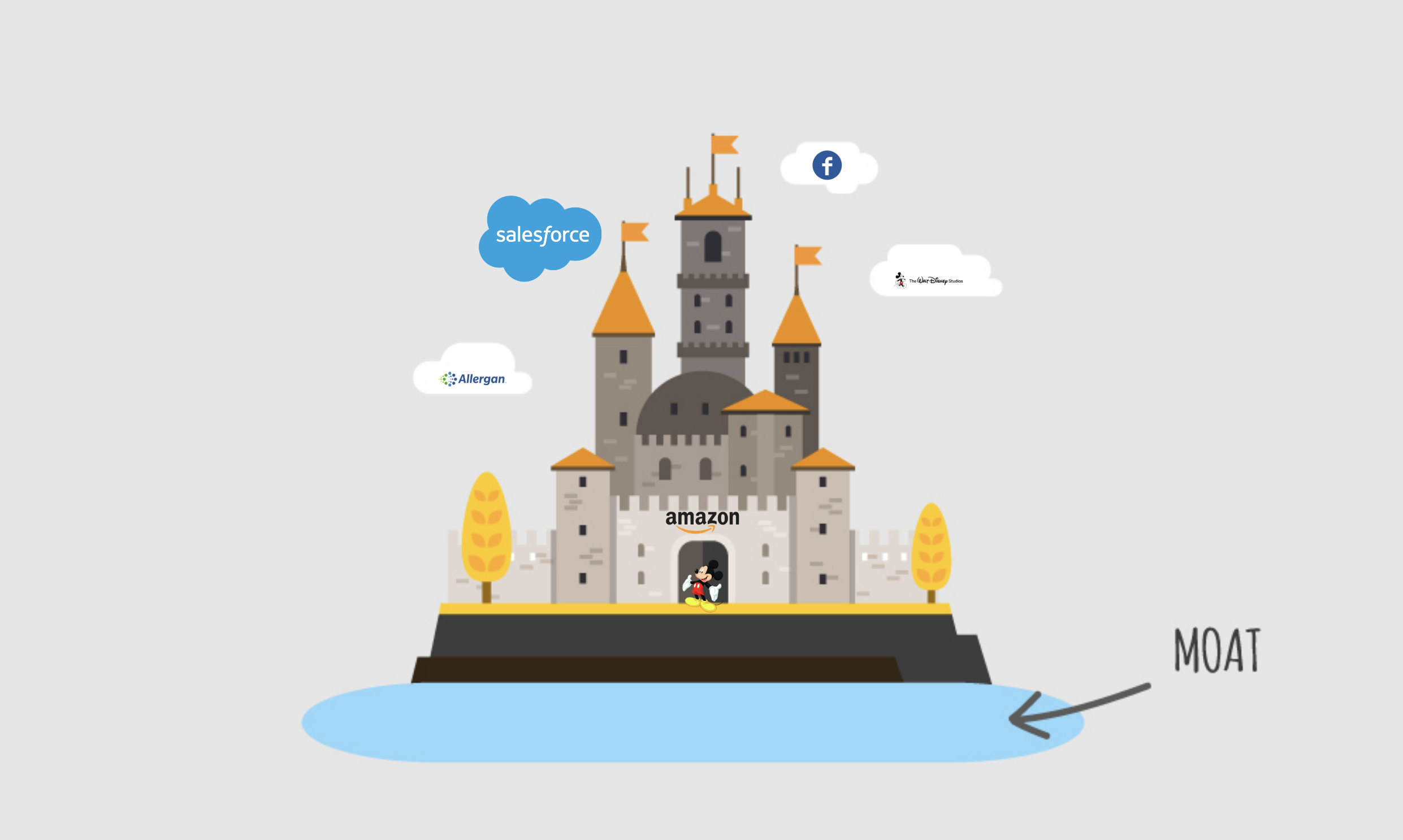
A moat is a throwback to the good ol’ days when castles (business franchises) needed a ring of water (competitive advantage) to protect them from the attack of enemy armies (competitors) who had heavy armour and weaponry.
You’ve probably seen our chart:
As you might expect, Warren Buffett popularised the moat metaphor and its importance in long-term investing.
“What we’re trying to find is a business that, for one reason or another — it can be because it’s the low-cost producer in some area, it can be because it has a natural franchise because of surface capabilities, it could be because of its position in the consumers’ mind, it can be because of a technological advantage, or any kind of reason at all, that it has this moat around it.”
– Warren Buffett, as quoted by Guru Focus
Why moats matter
Moats are important because they allow the company to compound capital over time (leading to more profits and higher valuations in future years) and also lower the fundamental or operational risk associated with a business. This two-pronged effect — sustainable growth and lower risk — amplifies the intrinsic valuations of the companies we own.
An author and investor by the name of Pat Dorsey, of Dorsey Asset Management and former Director of Equity Research at Morningstar, is one of the strongest proponents of identifying moats in investing. Here’s his great speech, given as part of a Google Talk:
In that 2014 speech, Dorsey draws on a lot of the principles in Michael Porter’s earlier books on the topic, Competitive Strategy (1980) and Competitive Advantage (1985).
Dorsey worked at Morningstar, the financial data and research provider, between 2000 and 2011 and helped their team of 90 analysts shape how a moat can be quantified and understood. Morningstar identified 5 sources of a competitive or economic moat (watch video), including switching costs, network effect, intangible assets, cost advantage, and efficient scale.
Note: there is an Australian ETF, VanEck Morningstar Wide Moat Focus ETF (ASX: MOAT), which targets 40-50 wide moat US companies trading at good valuations, according to Morningstar analyst research.
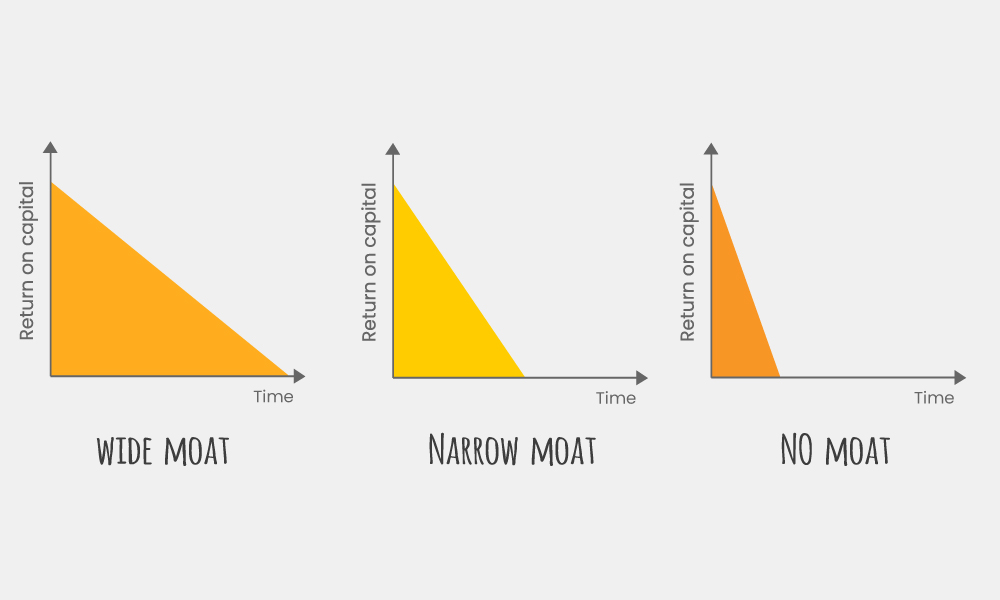
Morningstar says these moats allow a company to earn excess returns on invested capital (ROIC). That is, an ROIC over and above the company’s cost of capital (e.g. WACC). Through research, their teams of analysts assign a ‘wide’ moat for companies capable of withstanding competition for 20 years (that’s a long time), ‘narrow’ for 10 years of expected advantage and ‘no moat’ for a business which has a quickly fading advantage or none at all.
While I don’t much like brand as a moat, it’s an easy example. Dorsey makes a special note of Tiffany’s, the jewellery giant, in the video above.
Tiffany’s takes a $5,000 diamond and sells it with a $15,000 cardboard box. Meaning, you might get a diamond of the same size and quality from Zamel’s for $5k but give it a Tiffany’s stamp (which costs nothing, but has prestige) and it might sell for three times the amount.
(Note: I didn’t buy my wife’s diamond from Tiffany’s. I didn’t even buy it through a retailer, I went straight to the international market).
I think the reason Morningstar measures the moat as ROIC over WACC is that it makes the ratings (wide, narrow, no moat) fungible across industries and company size. For example, the definition allows you to compare a $500 million company in biotech with a $10 billion company in manufacturing.
How we measure moats
“…we are trying to figure out what is keeping — why is that castle still standing? And what’s going to keep it standing or cause it not to be standing five, 10, 20 years from now. What are the key factors? And how permanent are they? How much do they depend on the genius of the lord in the castle?”
Warren Buffett
Like Buffett, at Rask, our research work is done before a moat rating is applied. We don’t have labels (wide, narrow, etc.) but a score. Out of 100. Here’s a high-level perspective of what we’re looking for and the things we look at.
🎯 Note: our new stock checklist page is a great resource for Rask Core members. Click here.
| What we look at | Ways we think about it |
| Management | Capital allocation: ROE, ROA, ROIC, free cash flow, etc. Alignment: skin in the game, incentive structure. Integrity: language, transparency. |
| Industry dynamics | Total addressable market (TAM), competitors and their strengths, Porter’s Five Forces. |
| Uniqueness/brand | Gross margin, stakeholder feedback, comparables |
| Embedded products/services | Retention rates, Dollar-Based Net Retention (DBNR), loyalty |
| Network effect | Customer Acquisition Cost (CAC), specifically the change in CAC over time |
| Reinvestment potential | Incremental/marginal returns on capital (ROIIC, MROIC) or simply change in ROIC |
| Optionality | Strong balance sheets and free cash flow (FCF), R&D as a % sales, reinvestment rate (amount of net profit kept in the bank after buybacks and dividends) |
| Financials | Operating leverage (expenses rising slower than sales), working capital cycle, cash-to-debt, etc. |
Basically, our investment scoring is a score for business quality. Not stock market quality or investment return potential per se. The quality of the business. We are business-first, long-term investors at Rask because we believe, as Charlie Munger says, ‘time is the friend of a wonderful business’. We would rather overpay for shares in an exceptional quality company than underpay for poor quality companies.
Obviously, a key consideration when developing our process was how much weight do we place on different metrics. For example, ‘what makes a good management team?’ and ‘how much score (out of 100) should management account for in investing?’ A cynic would say even the most embedded business won’t succeed with a management team that scores a zero. That’s true. So the factors are linked.
We carefully balance the scores we provide against companies and have a separate section called ‘thesis killers’, which is basically 55 points that could subtract from the total score of a company. Dodgy accounting would subtract points, for example.
What a moat really means
If a company starts out as a ‘decent’ quality business or if you believe it can and will forge a wide moat in the future, a beautiful thing happens for stock investors. The company’s value will rise faster than everyone (especially other investors) imagined it would and the risk of owning that stock/investment (from a fundamental perspective) falls as the company widens its moat. So, basically, a wider moat plus lower risk equals substantial improvements in our valuations. We notice this all the time.
When we started out in positions of companies like Altium Ltd (ASX: ALU) (for Rask Invest), we held onto shares and witnessed its business become stronger and stronger over time. This allowed us to lower our discount rate of future cash flows (increasing the valuation) and gave us comfort to forecast more cash flow growth in future years.
This is why — if we do our job correctly — you should expect me/us to make fewer better investments over time. That is, I am looking for investments that can compound their intrinsic value — and hopefully your returns — for many years.
The key is identifying only the strongest companies with the widest moats, then holding on.