Last updated: February 17th 2023.
Apply to rough surfaces only.
Laserbond Ltd (ASX: LBL) is a little Australian company with 100+ employees, with its head office in an industry sector in Smeaton Grange, New South Wales. It’s about 60 minutes south of Sydney.
Founded in 1992 out of a small workshop in Ingleburn NSW, the company has gone from strength to strength, eventually listing on the ASX in 2007. LaserBond remains a family business and is led by Wayne Hooper.
Because it is so small, by ASX standards, Laserbond shares are very volatile — and it can be hard to find shares available to buy or sell.
⚠️ Only consider this company if you have experience investing in individual companies and/or are prepared to take high levels of risk.
What does Laserbond do?
Laserbond repairs heavy steel components (think: wheels for big trucks used at a mine) using sophisticated laser technology (“Services”).
It also creates brand-new products for equipment (“Products”), such as rollers or conveyor belts. Finally, it is now licensing its laser technology to overseas customers — bringing in high margin sales that keep customers coming back (“Technology”).
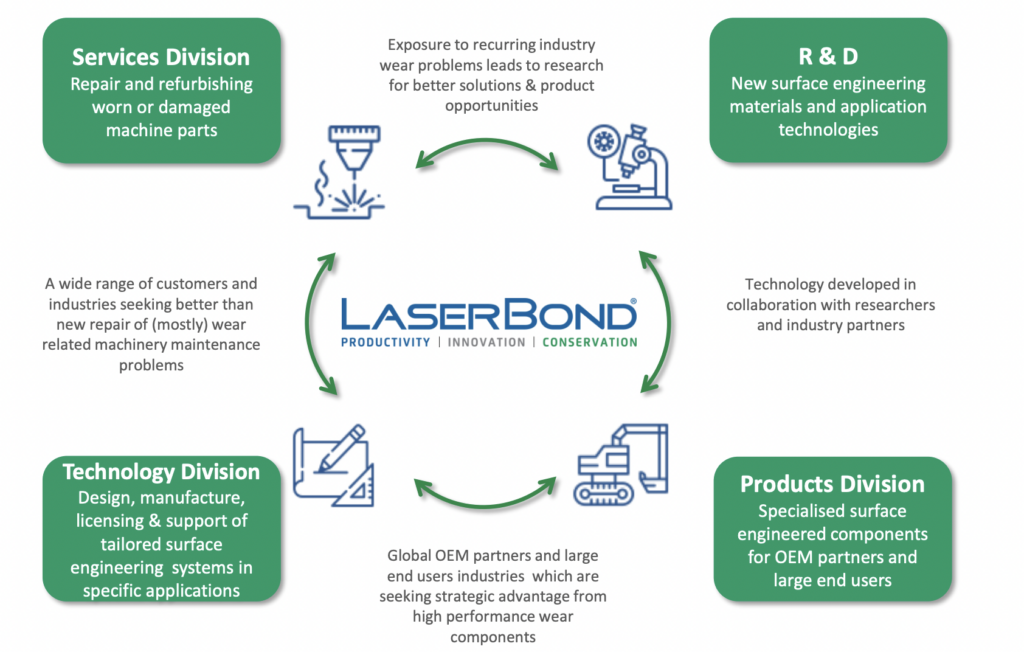
As of the date of this report, Laserbond is only a $100 million company but it is an industry leader in rebuilding parts to 5x or 10x their original strength. This makes Laserbond an interesting idea for anyone interested in the future of sustainable manufacturing. Or just anyone generally interested in the reduce, reuse & recycle movement like I am.
Laserbond’s laser machines are built here in Australia and are about the size of a truck or bus. The lasering process is only one part of a lengthy process that requires multiple steps inside a factory the size of a soccer field.
Laserbond’s customers are not the miners (e.g. BHP, Rio or FMG) themselves, they are the contracting company that does all of the servicing for the miners.
What I like
LaserBond does not have the sex appeal of a software stock (hello, SaaS). However, it’s a business that has demonstrated attractive long-term value creation and invested heavily to lay the foundation for consistent growth.
Since it was listed on the ASX, sales have grown at a wicked rate, as shown below. Importantly, while profits have been lumpy, margins have also improved over time — highlighting the sublime economics that is often attributed to management who care (e.g. founders, owner-operators) and have the ability to think long-term.
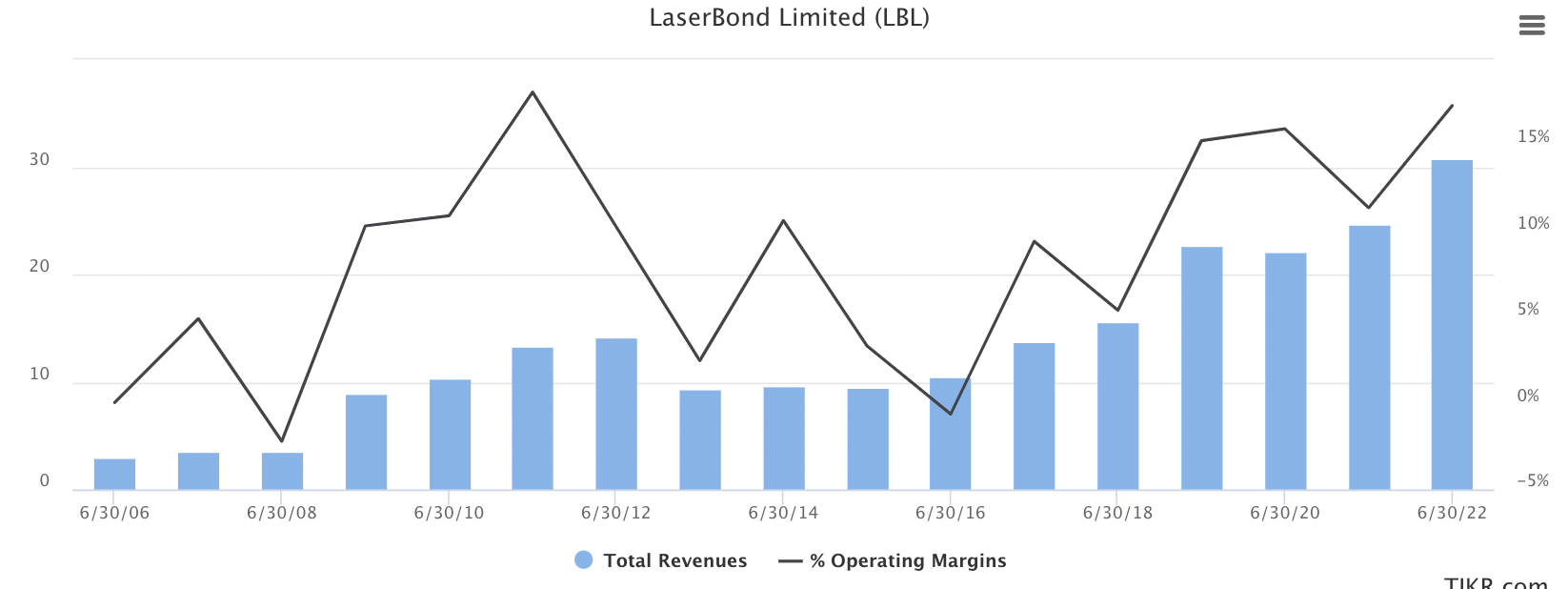
Laserbond benefits from both brownfield (acquisitions) and greenfield (new warehouse) expansion. This is evident in the years like 2009 (acquisition) and 2013 (divestment), but also in recent years as multiple acquisitions have taken place.
Through the early 2010s, Laserbond focused on reinvestment into its business at the expense of profits. For public companies, this type of ‘short-term pain, long-term gain’ trade-off is typically only possible when a family or founder controls the voting rights (more on below). The Hooper family own ~40% of the company.
When I visited the factory in 2021 to conduct our interview, above, the highlight of my tour by Wayne (CEO) and Matthew (CFO) was the laboratory. When we stepped into the lab, which is adjacent to the factory and the size of a small classroom, Wayne was visibly excited by the gadgets and testing equipment that their in-house scientists use for analysis and quality assurance. I’m pretty sure the ‘new’ machine they were using to test products was second-hand. Wayne still had the original machine his brother bought more than a decade ago.
By 2017, Laserbond’s profits had fully recovered to mining-boom levels and then surged a further 150% to hit fresh all-time highs by the end of 2019. Importantly, the seeds sown in previous years have yet more fruit to bear and investors today have the chance to buy into a more focused company, with a better offering and a good deal of operational flex.
You can see the company’s focus on operational excellence playing out with higher margins as it ramped up revenue. I think someone forgot to tell Laserbond it’s a manufacturing business…
Ongoing investment in plant & equipment has materially boosted throughput, while additional shifts and people could boost capacity utilisation. That is, LaserBond can sustain a good deal of growth without significant new capital expenditures. This is especially true now, in a post-Covid world, when its Victorian, Adelaide and Queensland sites can organically expand output.
A key risk to this view of increasing capacity is the rising cost of inputs (steel, components and people). Finding good people is one of the most challenging tasks for Wayne and his team.
A key growth driver for Laserbond can be seen in the way it innovates. Wayne’s family put together the first laser themselves. They pieced it together. On a budget (of course).
More recently (late 2000s and into 2010s) Laserbond has secured partnerships with universities like UniSA. Coming full circle, in 2021, Laserbond sold a machine to Curtin Uni for $960,000, which provided them with a foothold to collaborate with researchers and demonstrate to miners the ability of the technology. It’s no surprise to me they are now expanding into Western Australia.
On top of organic and acquisitive domestic expansion, and partnerships, Laserbond has a huge addressable market outside of Australia. While the opportunity is vast and uncertain (so I’ll refrain from throwing ridiculously large numbers into the ether) Laserbond claims to have industry-leading technology, which can be harnessed by manufacturing and engineering businesses overseas.
When I toured the facility I saw a few of the machines on the floor waiting for a single component (a chip) before being shipped overseas. These machines are complex and take months to complete.
One again, through collaboration with the likes of Austrade, Laserbond has been able to present at industry events and met potential partners based out of India, Brazil, Chile and Peru. The key now is not selling the technology, but ensuring the installs are implemented flawlessly. Management have set a target of two new licensing agreements signed and delivered every year.
To give you an indication of the economics of this opportunity, in 2021 Laserbond signed a deal in North America to deliver a machine for $1.5 million upfront. The deal also included licensing fees of $144,000 per year for 7 years and an additional $670,000 per year in consumables.
It’s hard to model these exactly, given Covid’s supply chain interruptions. But I will take management at their word and reckon $1.5-3 million of new sales per year, over the next 5 years is possible. That’s before the recurring component, which could be as high as $1 million per unit. So, after 5 years, that’s an additional $10 million of annualised revenue. With, I’m assuming, near 80% margins on the licensing ($1.5 million per year of revenue = $1.2 million of gross profit) and 20% on the consumables ($1.7 million) it begins to look like a serious contributor to growth.
Financials & valuation
Laserbond is a small and extremely illiquid investment idea — meaning, it will be really difficult to buy and sell shares at a fair price, even in a normal market.
With FY22 revenue of $30.7 million and a first quarter FY23 update showing growth of 36%, momentum could be building. I think a DCF valuation, which is taught to students in my Value Investor Program on Rask Education, could be done. But I’d prefer to keep it simple.
Laserbond’s historical average price-earnings ratio is around 24x, which is consistent with the current multiple.
Assuming the company can compound its top line (revenue) at 30% in 2023, then 20% for the next few years, with improving margins — I can see how that *might* look, if the valuation multiple is maintained.
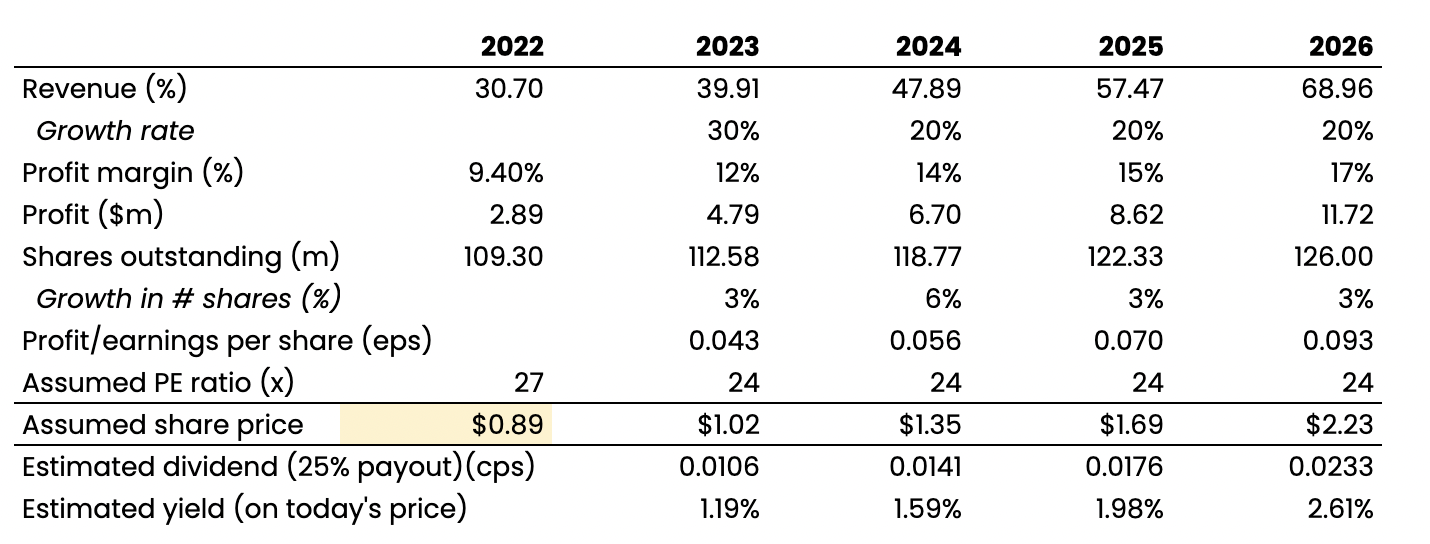
There are absolutely no guarantees Laserbond can achieve this type of growth, the profit margins or any of it. But I’m quite confident and happy to back management.
I never rely on my valuations as a hard science. Nonetheless, this basically tells me that if I could buy Laserbond shares below $1.00 per share I think it is quite a good deal.
Management
LaserBond has been a family affair since its inception, Hooper family remains very much a key part of the business.
Formerly a technical specialist in metallurgy and welding applications, Gregory Hooper founded the business 29 years ago and was responsible for the research and development of the company’s Thermal Spray and LaserBond cladding processes. Greg stepped down from the CTO role a while back.
Wayne Hooper joined his brother Greg in 1994 and has held the role of executive director and CEO ever since. An engineer by training, Wayne’s focus is on sales, marketing and operations. Wayne, alongside his mother, is now the single largest holder of shares at 8.94% — a very meaty holding that keeps him incredibly well aligned.
The Hooper family still owns more than 30% of the business, keeping them aligned and focused on long-term wealth creation. Wayne leaving or selling down his stake is an obvious risk.
Risks
The company has begun making acquisitions, which are always risky, and new greenfield expansions are likely. Given the alignment of the Hooper family, I highly doubt they’re going to search for short-term gains at the expense of long-term wealth creation. While they have the influence to do it — and I doubt they’ll do it — ugly incentive schemes, cushy remuneration structures or other types of internally focused decision-making could harm outside investors.
However, I am conscious that the business must be prudent with its capital allocation because there are a lot of competing priorities — new sites, expanding current throughput, incentivising new and current employees, technology sales, etc. All the while, the company must oversee culture and retain focused executive leadership.
As we saw in 2013, a significant and sustained weakness in the customer base would have impacts for LaserBond. This could happen if mining, infrastructure or manufacturing conditions took a turn for the worse. There’s good solace in knowing that the business has a broader customer base than before, but it’s something to be mindful of.
Another risk is inflation and labour costs. I hope these are transient risks. Meaning, they would only be temporary (one or two years). But they could persist and be irreversible and result in all of my basic forecasting being completely wrong.
Finally, please be warned that Laserbond is a tiny ($100m) company and shares can be extremely volatile and hard to sell when you need the cash. A true 3-5 year time horizon is necessary for this one. Don’t be surprised to see this company’s shares rise or fall 20%, for no reason.
You don’t need to own individual shares. We have an excellent Core portfolio.
Summary
After decades of toiling and a culture of sensible growth, I think Laserbond is now a well-oiled, family business with a brighter future and tailwinds at its back.
So long as Wayne and the Hooper family remain involved in the operations and/or strategy of the business, it’s a company I would be very happy to hold as a small part in a diversified portfolio (e.g. 1-5%).
I’ll likely buy shares of Laserbond for myself and The Rask Group throughout 2023.
***
Disclosure: at the time of publishing, Owen Raszkiewicz does not have a financial interest in any of the companies mentioned.
General advice warning: The information on this website is general financial advice only. That means, the advice does not take into account your objectives, financial situation or needs. Because of that, you should consider if the advice is appropriate to you and your needs, before acting on the information. If you don’t know what your needs are, you should consult a trusted and licensed financial adviser who can provide you with personal financial product advice.