Robbo asked us — Owen here — a fantastic question in the Rask Core community.
Note: you can join Pearler for free and use the “rask” coupon code to get $15 of free brokerage (equivalent to free trades on 2 investments). We/Rask don’t earn affiliate fees but they are a long-term sponsor of our Australian Finance Podcast 🙂
As many of you will know, Pearler offers free brokerage on select ETFs (e.g. those from VanEck, eInvest & Global X ETFs) if they are held for 12 months or more. Basically, you can buy ETFs inside Pearler, but only from these issuers for free brokerage.
Pearler’s usually going to charge you $6.50, or $5.50 if you prepay, to buy an ETF or share using its platform.
Why?
For Pearler: they encourage long-term investing; it’s also a competitive advantage for Pearler over other brokers. Who doesn’t love free brokerage!?!
For ETF issuers: when you invest in any ETF the issuer/provider takes the fees out of your investment every day, automatically. This tiny fee (e.g. 0.1% per year divided by 365 days) is already reflected in the share price you see. For example, on $5,000 invested in VanEck’s Global Quality Shares ETF (ASX: QUAL) you will incur yearly fees of 0.4% or $20 (taken out by VanEck daily). So, clearly, they benefit from you investing in their ETFs.
⚠️ My thinking behind ‘should I use free ETFs’ is the same thinking behind people trying to place their buy or sell orders inside a brokerage account down to the cent per share. Over the long run, it probably won’t matter! Let me explain…
Robbo’s question:
I was wondering….. given Pealer is a sponsor of the podcast, if you were to pick from the “free brokerage” ETFs on Pearler to make a core and satellite portfolio, what would you(and/or Owen) choose?
Free ETFs 💸
@robbo888, great question about free ETFs, mate!
I also agree that it’s a fantastic feature from Pearler — the team is super impressive. Did you know if you sign up to Pearler using “Rask” as the coupon code you get brokerage credit? We’re working on some other perks for Pearler + Rask customers (due out this month — stay tuned).
There are some great ETFs available for free on Pearler (e.g. from VanEck, Global X, etc.).
Things like QUAL (a quality-focused global shares ETF) and MOAT (competitively advantaged US companies ETF) spring to mind. VanEck also offers MVW — which is its Australian shares ETF, but quite a bit different (equal weighted, about 100 shares only).
When it comes to ETF investing for the long-run (10-20 years) I think the benefits of not paying the $5.50 in Pearler brokerage (if you pre-pay — or $9.50 with Selfwealth, or $4(?) with Stake or $10 with Commsec) is a lesser option than getting the right ETFs you want to own and just copping the fee.
I tend to invest in ETFs with $1,500+ chunks minimum because overall that’s a fairly good amount to overcome the cost of brokerage (e.g. if the once-off brokerage to buy a parcel is $5.50, on $1,500 invested, that’s 0.3% of the purchase price — whereas on $500 invested it’s 1.1%).
Example of VAS versus MVW 🎯
Let’s imagine that instead of buying Vanguard VAS (300 companies, 0.1% fees — but it costs $5.50 brokerage for each buy) you buy MVW from VanEck (100 companies, equally weighted, 0.35% and $0 brokerage).
In bullet points:
- You make 4 investments a year.
- So $1,500 invested every 3 months
- Assume the 5-year average return from MVW & VAS are used (just as an examples; VAS = 9.31% p.a. after fees, MVW = 8.26% p.a.)
- It’s $5.50 to buy VAS
- It’s $0 to buy MVW
- ⚠️ Note: Brokerage costs can be offset against capital gains for tax purposes (i.e. it positively impacts an investor’s ‘cost base’)
Using the returns from our portfolio builder tool (data to July 2022), you would observe:
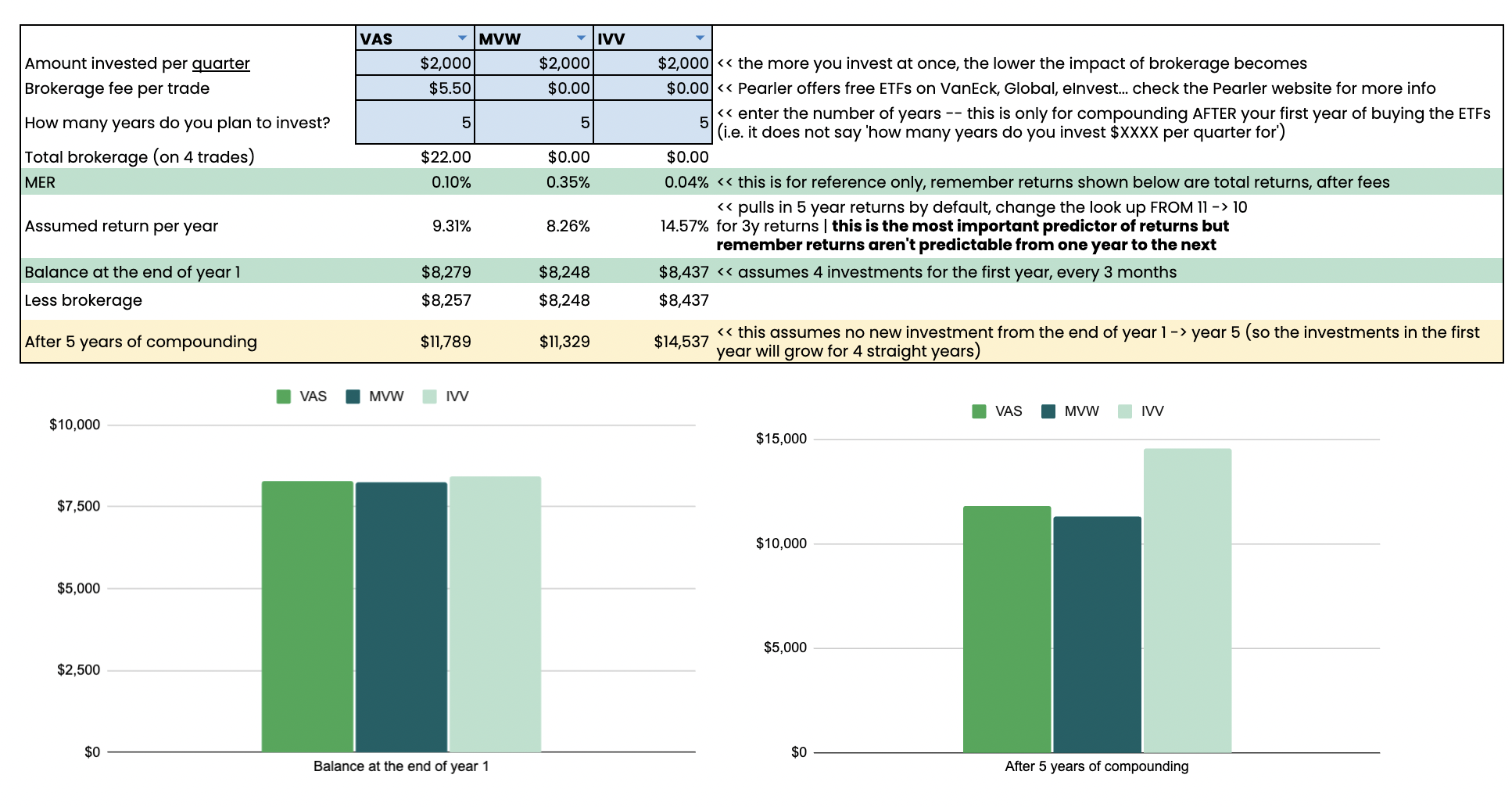
As you can see — and this is hypothetical because it uses two similar performing ETFs — over just one year, it would seem VAS and MVW are neck-in-neck.
But also remember, we only pay brokerage once and this is over 12 months.
If VAS — due to its lower fees and increased diversification — continues to outperform MVW over 2, 3, 5… 10 or 20 years, the original investments will be growing faster and faster (on increasing amounts of money invested), so the differences would become more and more profound… (in favour of VAS).
Obviously, you could keep investing every 3 months for 5, 10 or 20 years (and incur more brokerage) but the math would be the same — it would just keep rolling on.
Does this make any sense or have I lost the plot? Jump into the forum and let me know.
For portfolios, I think some of the ETFs offered by Global X, eInvest and VanEck might be good for the Core. But many of them tend to be ETFs that I would consider as ‘satellite’ positions only.
You can sort our list of ETFs (on Desktop or Tablet) using this tool:
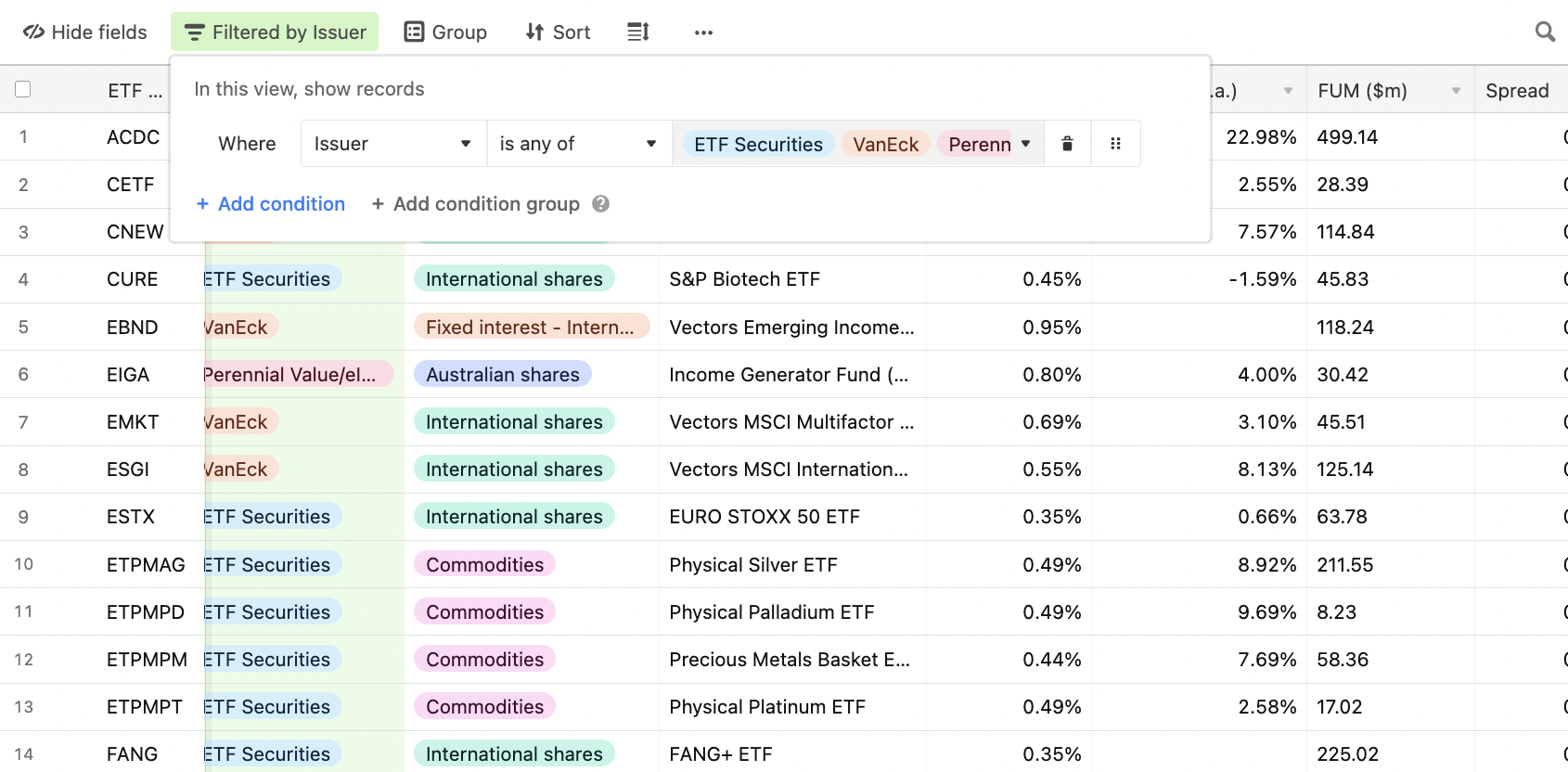
Amongst the ETFs, those that stand out to me are:
- GOLD – satellite or core
- ACDC – thematic
- IMPQ – active small caps, satellite
- QUAL – global shares, core or satellite
- MOAT & GOAT – US and global shares, satellite position
- ZYAU – satellite dividend ETF, Australian shares
There are others, but those are a short list for me.
Summary
The free ETFs from Pearler is a fantastic initiative because it lowers the barriers and encourages long-term investing (which is a very rare thing from brokers!). Their philosophy to investing is the key reason we’ve partnered with them on our podcasts — and not Stake or Commsec.
However, I think investors (especially new investors) get too caught up in low fees being the only thing that matters — it isn’t. It’s similar to how some investors get worried about placing ‘buy’ or ‘sell’ orders within a few cents of the last share price (thinking that getting an extra few cents on the order will matter over the long run — it won’t).
If we’re truly long-term investors, focus on picking the right ETF the first time.
Owen