REA Group (ASX: REA) is the gatekeeper of real estate activity in Australia. The eponymous realestate.com.au domain is visited each month by more than two-thirds of the adult population and, somewhat remarkably, is more popular than both Netflix and Amazon.
Key Points:
- Network effects
- Low cost, high value
- Business model evolution
The realestate.com.au website represents a digital town hall, aggregating potential real estate buyers, sellers and hopefuls in one place for real estate agents to advertise and engage. With more than three times the traffic of its nearest competitor, operated by Domain Holdings Australia (ASX: DHG), REA has tremendous pricing power with sellers and, over time, has extracted a greater percentage of the property transaction economics. This has translated into strong profit growth and a share price that has appreciated on average 32% per year over the past two decades.
Internet Disrupts
REA co-founders Martin Howell and Karl Sabljak believed the proliferation of the internet would present opportunities for democratising different information. After picking up the Saturday paper and realising most pages were dedicated to real estate classifieds, the idea of a digital property website was born. The duo purchased the domain name realestate.com.au and set to work.
At the time, property advertisements were only available in print, limiting overall awareness and therefore the potential pool of buyers. Price discovery was limited, and sellers relied on the imperfect advice of agents to market properties.
The shift to the internet would change this in a big way. Information was now widely accessible, properties could be compared effortlessly, and price asymmetry was reduced considerably. While there were no more blatant bargains to be had, it didn’t matter for REA because marketing budgets shifted away from classifieds and towards its website.
The website did however run into challenges early on. Agents didn’t have computers, let alone the skills to digitally upload photos. There was also the mental hurdle of convincing sellers to post photos on the relatively nascent World Wide Web.
Then the internet bubble popped in 2000. It torpedoed REA’s share price by 90%. The business agreed to a shotgun funding arrangement with News Corp (ASX: NWS) to provide much-needed capital and marketing exposure. The media giant remains REA’s largest shareholder, with a 61% stake.
Innovator’s Dilemma
REA had a four-year head start on the competition, with the large classifieds player being Fairfax (owner of AFR and other newspapers), not going digital version until 2000. The real estate assets of Fairfax were separately listed into what’s now known as Domain Group (ASX: DHG). Despite REA’s early start, Domain had the benefit of incumbency, and therefore a large reader base to promote its new property website.
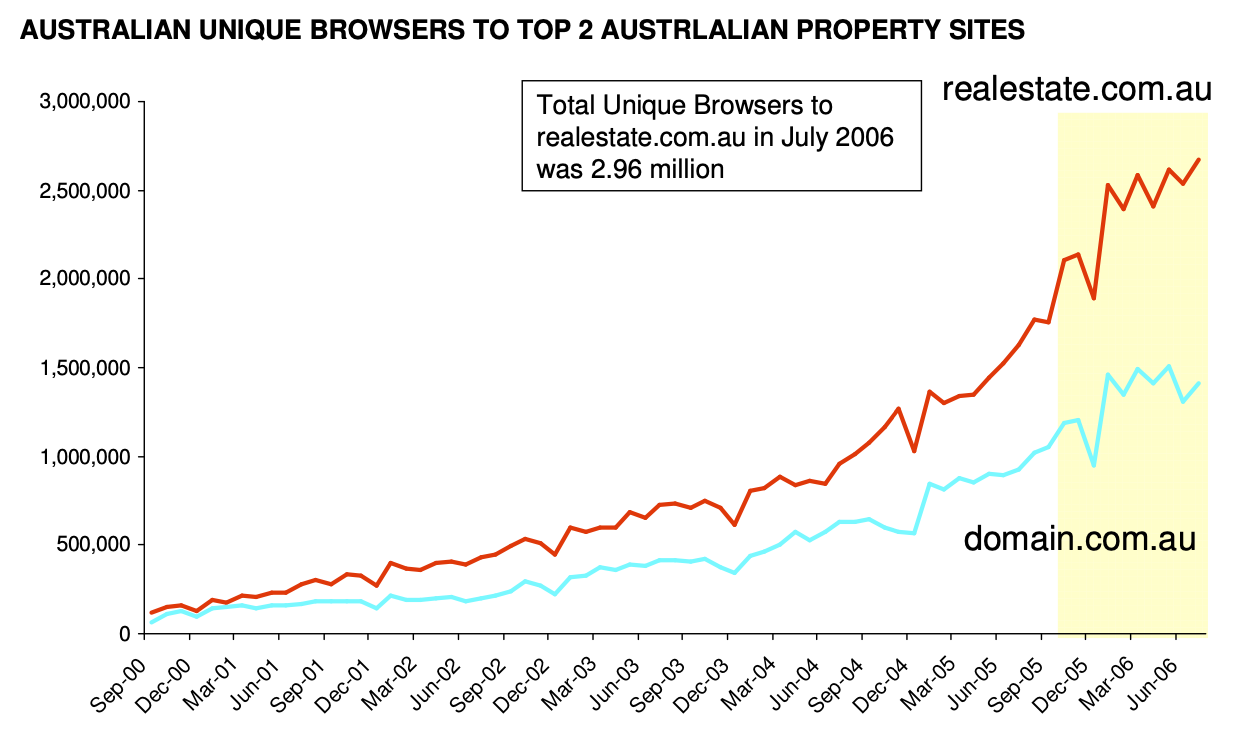
However, the Fairfax newspaper suffered from innovator’s dilemma. This occurs when an incumbent is either unwilling or unable to innovate (e.g. sell properties online), because it would cannibalise an existing division (the printed version). In this case, its very profitable print classifieds business. By contrast, REA had no such burden, and thus the business was able to disrupt Fairfax and the broader market with a much better value proposition.
Soon after this, REA had the lead over Domain. The flywheel only kept spinning: more buyers on realestate.com.au attracted more agents which meant properties, and so the cycle repeated. By the late 2000s, it was a foregone conclusion Fairfax/Domain had lost its hold over property advertising. REA had created and benefitted from network effects, where the consumer benefits of the website increases as more people visit. After all, if every property listing was on REA, why would you bother going to Domain?
Domain tried a multitude of methods to retake its prized mantle. Offers such as discounted listing packages and rewards programs for agents failed to make a dent in REA market share. Most agents who use REA also use Domain, but REA captured the market by moving first. This was a game of winner-takes-all, and there was no prize for second place.
Squeezing the Lemon
REA initially monetised its website by charging agents for listings, much like traditional classifieds. Then the business pivoted into a subscription model where agents paid to play. Revenue increased from $5.9 million in 2002 to $60.9 million in 2006. Most would have stopped there, but there was more juice to be squeezed.
Despite the mission critical role it played in marketing properties, the cost of property listings represented only a fraction of the transaction economics. Agents took between 2-3% of the sale proceeds, even if a property was worth $2 million, whereas REA only charged a few thousand dollars for advertising. Clearly, REA was adding a lot of value but not taking as much of the pie for itself.
The business introduced depth products. This is industry lingo for premium listings. Sellers would be willing to pay extra for feature listings, guaranteed top spots and banner advertising. Rather than a fixed subscription, the price would be set by sellers in the marketplace. As a result, more expensive suburbs were willing to pay more for the heralded top slot. If a small amount of extra advertising spend on REA could add thousands to the property sale price, the payoff for agents was obvious. Today, Australian listings revenue is over $900 million with the bulk of that from premium depth products.
Land and Expand
After displacing classifieds, REA has taken the mantle as the incumbent. While the core Australian marketplace remains a wonderful business, profit growth from this division will likely moderate going forward. The business has sought growth by deploying profits into adjacent product offerings to extract more value from the property ecosystem. This includes buying the mortgage broking business, Mortgage Choice, for $244 million.
REA provides rental applications via 1form, mortgage applications via Simplogy, mortgage brokering services through Mortgage Choice, and data and analytics. REA has also attempted to replicate the model in new countries. While still nascent, investments in Southeast Asia, India and the United States today represent 20% of revenue. Investors should watch these divisions closely as we think they appear to represent the next leg of growth.
In a weird quirk of investing, there may one day come a time when REA finds itself facing an innovator’s dilemma. But for the time being, REA remains one of the strongest businesses on the ASX.