⚠️ If you haven’t already read my update from last month, Hunting for Anti-Fragile Companies, I strongly recommend you read that before continuing below. This link opens in a new tab.
***
Washington H. Soul Pattinson & Co. Ltd (ASX: SOL), “WHSP” or “SOL”, is one of Australia’s oldest public companies, tracing its roots back to 1872, when Caleb Soul and his son, Soul, opened a pharmacy in Pitt Street (hence the name “Pitt Capital Partners”, which finance types will know as the fully owned investment bank of WHSP).
In 1886, not far across town, Lewy Pattinson opened a pharmacy in Balmain, NSW.
In 1902, Lewy Pattinson bought out Caleb Soul to create what is now known as Washington H. Soul Pattinson & Company Ltd. It listed on the stock exchange in 1903.
Over 100+ years on and WHSP continues to be steered by descendants of the family who came together to form it. The Millner family are still at the helm (Rob Millner, current Chairman) and waiting on the bench (Tom Millner, a director).
Rob’s uncle was Jim Millner, a prisoner of war turn pharmacist, who later became perhaps the most ambitious of the company’s leaders, leading the company as Chairman from 1969 to 1998.
Jim’s great-grandfather was Lewy. Talk about an interesting family tree.
Why I’m attracted to WHSP
In addition to being an ‘owner-operated’ company. Or, more specifically, a family-run company (which I’ve found can be even better than founder-run companies, at times).
Throughout its many decades of operations, WHSP has achieved something that only a tiny percentage of businesses can ever achieve — the ability to be “anti-fragile”. The way I define it is a number of traits that allow a company to get stronger when it takes body blows.
Importantly, this concept goes beyond ‘not breaking’. These traits allow it to emerge stronger. Just imagine dropping a wine glass and it bounces above your head.

Even amongst the best investors I’ve met, this concept is uncharted because it is very difficult to quantify using typical financial metrics.
To understand what I mean by anti-fragile requires the deepest understanding of a business by insiders, an unwavering belief in a set of company values, strong leadership abilities founded in humility and integrity, and aligned shareholders. Furthermore, things like industry growth and favourable Government or regulatory conditions help these businesses thrive.
What does WHSP do?
WHSP is not your typical ASX-listed company.
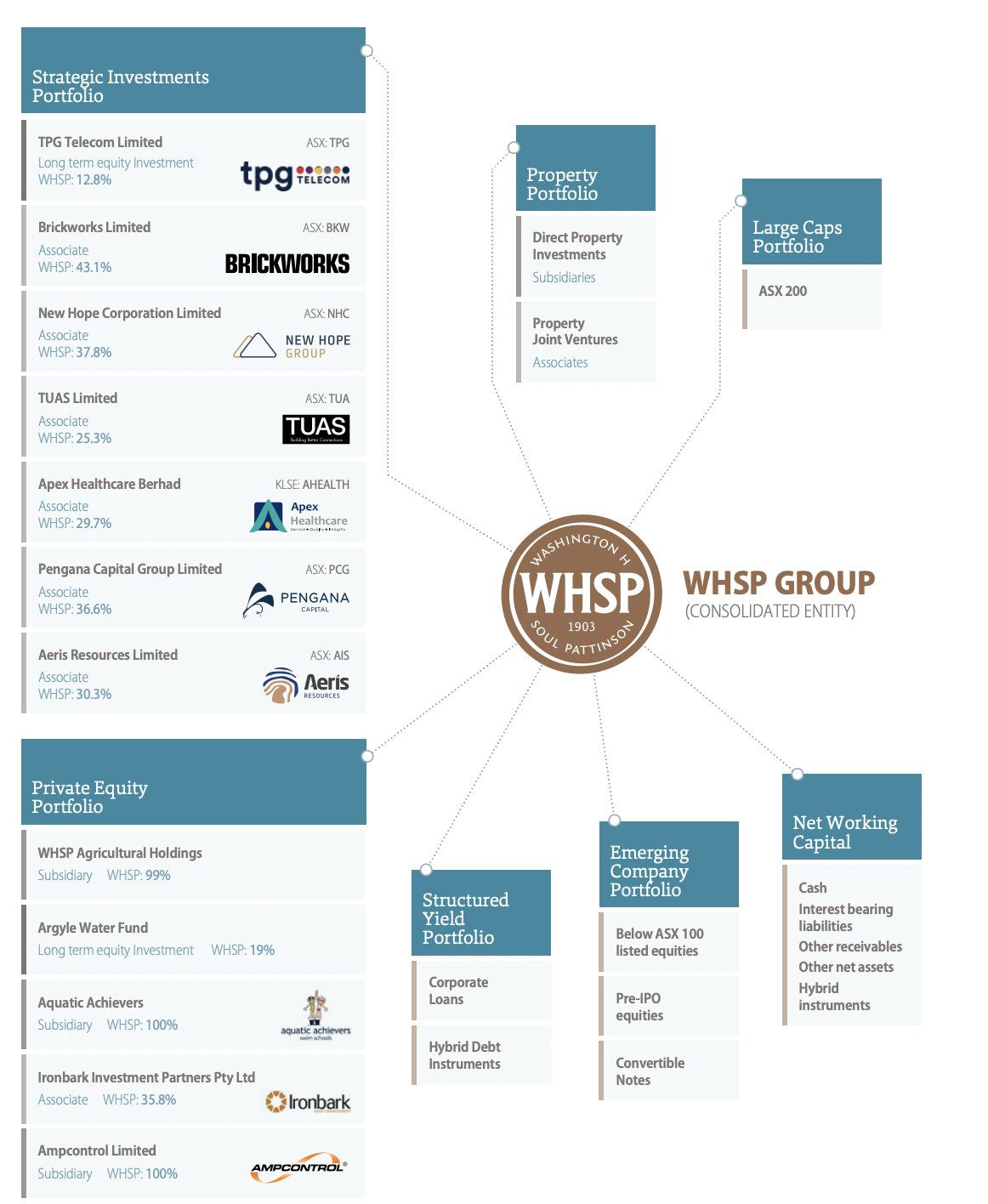
It’s a conglomerate that owns partial stakes in other companies, like TPG Telecom or Brickworks (ASX: BKW), or buys them outright (e.g. AMPControl). It benefits from these companies by getting dividends back and, eventually, usually years into the future, selling them at a profit.
Beyond just buying then holding chunks of other companies, WHSP is also a lender of capital (what it calls “structured yield”) and an emerging fund manager (i.e. soon it’ll allow outside investors like us to pool our money in a fund and WHSP’s investing team will invest for us). These two divisions of the business are very exciting to me because they will magnify the return from what WHSP is already doing. Meaning, more profits and dividends for WHSP shareholders — for a tiny amount of incremental cost and effort.
To be clear, WHSP is not a ETF. An ETF like VAS or IVV is a legal trust (WHSP is a company), ETFs are often passive (WHSP is actively managed), and ETFs can only invest in public markets plus things like stocks and bonds (WHSP can buy an entire private company if it wants to).
Also, WHSP is not a Listed Investment Company (LIC). A LIC like AFIC or Argo is set-up purposely as a holding company (whereas WHSP can operate businesses) so a LIC is typically restricted to owning ASX or global shares — WHSP can buy whatever it wants.
Why we like WHSP
WHSP is everything we could want in a 20-year investment. In short, it has 5 characteristics that make it incredibly unique:
- Cross shareholding & permanent capital – for decades WHSP has owned a huge chunk of Brickworks (ASX: BKW), the leading brick manufacturer, and vice versa. The cross-shareholding has even survived court cases by aggravated fund managers who have sought to break it up for a short-term profit (or for competitive reasons). In short, this relatively unique trait means WHSP (and BKW) can’t easily be influenced by outside investors who have a short-term focus. In other words, it protects WHSP’s management and long-term shareholders alike.
- Legal structure – as a company, WHSP can hold onto it profits or franking credits for as long as it wants to (or until its board determines otherwise). It can own operating companies, shares, bonds, whatever! For example, if WHSP made a $1 billion profit on an investment in a bull market, it could hold onto that cash for years until markets crash and it gets a better deal to buy a company in a down market. Rinse and repeat.
- Uncorrelated investments – given #1 and #2, WHSP can make big and bold investments for the long haul, and it doesn’t have to dress it up with a fancy “narrative” when times get tough— like a fund manager, private equity or Super fund (or else risk getting fired). For example, WHSP bought coal businesses at attractive prices, optimised the mine sites and waited for prices to rise, then offloaded them. Few fund managers could do this because 1) they’d be fired if coal prices stayed low for too long; d) ESG-focused investors would petition against them owning coal, and so on.
- Low cost mindset – one of the reasons we know index fund ETFs outperform is simply due to low fees. In talking with WHSP CEO Todd Barlow a few weeks ago, he told me that they believe the equivalent cost of running WHSP is about 0.3% per year. To put that in context, the average ETF in Australia charges ~0.48% per year while LICs charge, on average, closer to 0.8%. All else being equal, on $100,000 WHSP would put an extra $180 in your pocket every year, and might compound that faster than an ETF or LIC. With so much insider ownership and alignment, there is little reason for WHSP’s team to add extra costs.
- Owners mindset – characteristics 1-4, above, are all extremely supportive of an investor or “owner” who would want to express a view on a company, invest for the long-term and exploit the short-term focus of other investors. Over generations this environment and alignment has fostered an ownership mindset, allowing the investment teams and management of WHSP to make confident, ultra-long-term focused bets on companies. It’s this final variable that enables WHSP to invest confidently when others are scared and in doing so, bounce the wine glass back up during a downturn. As Todd said to me, he treats managing people’s money as an honour.
Some companies possess some of these traits. But it’s extremely rare to find all of them in one company. That’s what makes WHSP special.
Management team
WHSP is headed up by Rob Millner, Chairman. In the office, next door, is Todd Barlow, CEO. You can find a full interview with Rob Millner on Rask Media. And I’ve included the recent Australian Investors Podcast with Todd below. Grab your popcorn 🍿 it’s one hour and 20 minutes of business gold.
It’s very hard to pin down one specific reason why the institution of WHSP has done so well, but clearly it has something to do with its people. And its people, who could get a job anywhere in the finance world, clearly want to be part of it.
So, without key leaders in the business like Rob, Todd and Tom Millner, we would second-guess our position in the company. Remember, if we buy and plan to hold for 20 years from today, we’re effectively betting on Todd and/or Tom and their team to drive results, not what happened in the past.
Todd rose internally through WHSP, starting with the company inside the investment banking business, Pitt Capital Partners, where he worked for many years. It’s good to see this given the importance of cultural continuity.
Tying the key insiders to the company we have:
- Tom Millner – 5.99% of shares. Worth $677 million.
- Rob Millner – 6.23% of shares. Worth $704 million.
- Brickworks – 26.1% of shares. Worth billions.
- Todd Barlow – 210,066 shares, worth $6.6 million (plus a further ~$7 million in deferred shares)
That’s a lot of scratch to keep them motivated for long haul.
Incentive structure
Todd is paid around $1.5 million per year (as of FY22) but can earn additional long-term performance incentives.
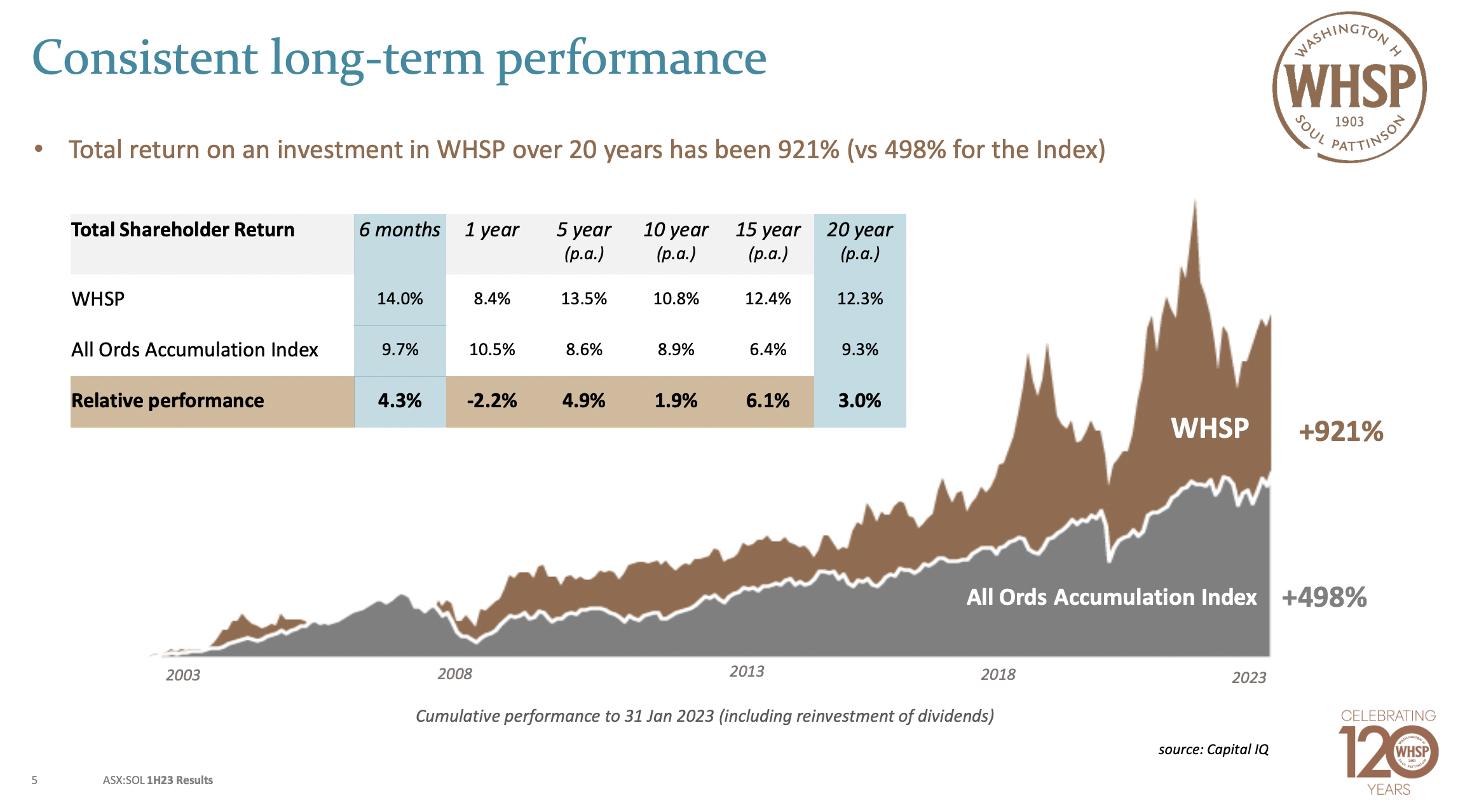
The company’s incentive structure is designed to offer the maximum benefit to insiders, if the company outperforms the All Ords Accumulation index by more than 3% per year, measured over 3 years (in dividends and share price). As WHSP grows, this is going to be harder and harder for management to reach, but I love the ambition in the target (after all, it also means they’ll get wealthy by growing the value of their own shares). I think a better target is five years, not three. But three is better than anything shorter.
You can see the historical performance below.
WHSP also has hurdles for net assets per share (previously it was earnings per share) whereby management make between 50% and 100% of their long-term bonus if they achieve between 5% and 10% per year in growth in net assets per share. Net assets are just what’s left over on the company’s balance sheet every year, minus loans and debt. It’s the same as equity in your house.
Using net assets basically means management is destined to grow the investment pool that it can then use to grow the next year, without taking on heaps of debt. Net assets is how Warren Buffett calculates the intrinsic value of companies he buys. It’s also a useful metric because it encourages WHSP to support the growth of New Hope Coal (ASX: NHC) and Brickworks (ASX: BKW), two of its biggest holdings.
Financials & valuation
You should expect a company that’s been a family-run for decades to be managed prudently when it comes to the financials, to ensure it never ‘breaks’. After all, taking on too much debt is a great way to ruin a good company.
At the end of 2022, WHSP had ~$309 million of debt countered by ~$645 million of cash. In other words, it’s rock solid. Everything about WHSP has longevity in mind, even its balance sheet.
There are a few ways you can value WHSP shares, but in practice it comes back to using either dividends (and assuming some growth) and/or net assets (which is impacted by the company’s ability to reinvest the dividends it receives for more dividends in the future).
Using dividends is how I would value ETFs and bank shares.
Basically, using a dividend discount model (DDM) you assume a risk rate (e.g. 8% per year), which is the return you would ‘demand’ for owning this risky investment (i.e. you think ‘to take the risk of owning WHSP shares, what return per year do I desire?’). Next, you assume the dividend grows at a steady rate forever. This is a risky input because technically nothing grows forever. So keep it reasonable and be able to justify it.
Finally, you input this year’s dividend per share. You should also include the impact of franking credits, assuming you can receive them. For example, valuation = $1.20 / (8% – 3.5%) = $26.67.
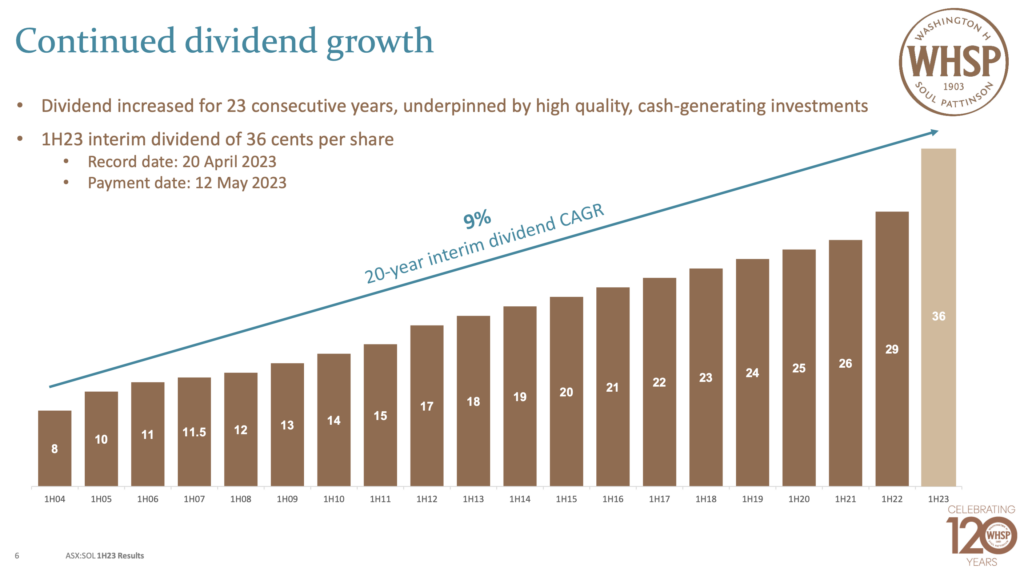
As you can see above, the company’s half-year dividend has grown at 9% per year. Putting that type of growth in our model would cause it to explode to an irrational valuation. So, I’ve been conservative and assumed the growth in dividend payments slows down.
I’ve made a demo dividend valuation model here (Value Investor Program students will have access to much more sophisticated models). Remember, use the model at your own risk. Garbage in, garbage out.
In fact, I’m including this section on valuation solely for illustrative purposes. I’m not relying on a valuation model to make this investment. But it does provide a useful yardstick.
Finally, we can study the company’s net assets and see what other investors have, historically, been willing to pay for the shares. In 2002, WHSP’s net assets (“book value”) per share was $2.47, it’s now $23.07. That’s the power of consistent compounding!
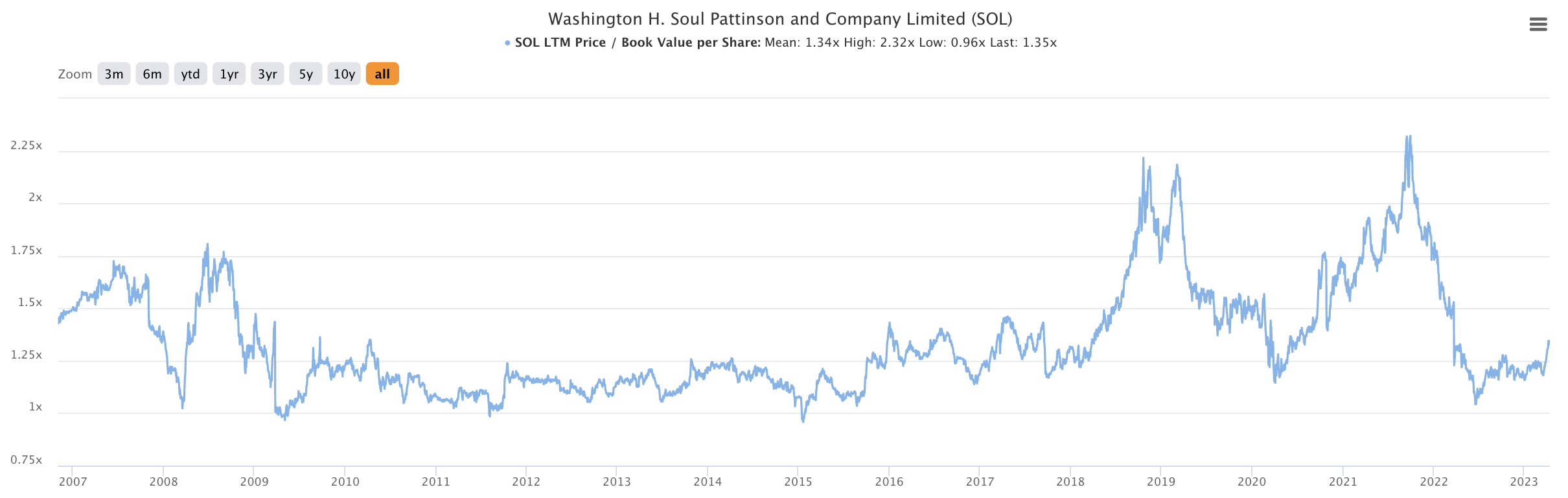
Source: Tikr.com
From the chart above, you can see that investors, historically, have been willing to buy or sell shares of WHSP for, typically, between 1x and 1.5x the value of the assets shown on the balance sheet.
Currently, WHSP shares are right in the middle of that multiple — around 1.3x. While the past is not a guarantee of the future, it seems normal to see WHSP’s net assets grow by 5-10% per annum. As it gets bigger, however, the returns investors expect should fall. Just as Warren Buffett says his returns would be (and were!) much better when he had $10 million to invest versus $200 billion. I’m sure the Millner family would say much the same.
All things considered, my investment is much more a belief-based investment than a value-based investment. One of the risks to this type of investment is we won’t know the outcome for 5-10 years. Some other risks can be found below.
Risks & when I’d sell
WHSP is a very unique business in that, like Warren Buffett’s Berkshire Hathaway there are few obvious reasons that would trigger an instant sale of shares. However, here’s what I’ve come up with for reasons why I’d reconsider my position:
- A sudden or slow violation of any of the 5 competitive advantage characteristics, above. For example, if the company began to over-capitalise, hire too many people or ‘build an empire’, the cost advantage (advantage #4) that WHSP currently enjoys would be broken.
- Excessive leverage – WHSP has a very lean operation, but it can be alluring for professional investors to load up their balance sheet with debt because they think, ‘our returns should exceed the interest payments, so why not use debt?!’ Famous last words. Some debt, especially at the underlying company level (e.g. TPG or Brickworks), is acceptable and encouraged. However, it’s something to keep an eye on for the parent (WHSP).
- Loss of leadership and/or alignment. If the Millner family or the likes of Todd Barlow resigned and/or sold out their shareholding I would reconsider my investment. It’s unlikely, but possible.
- Sustained underperformance within its investment portfolio. If over, say, five years WHSP underperformed the market with its investments I would begin to reconsider my positions. However, some years of underperformance is normal.
Core or Satellite?
While it could easily be found in either part of a long-term portfolio I’m parking WHSP in The Rask Group’s Satellite portfolio, for now.
It ticks a lot of the boxes for a Core position (low cost, diversified, etc.) but it’s not quite the same as one of our chosen Core ETFs. So, for now, it’s a Satellite position. But that could change in time.
***
Please let me know what you think about WHSP in the Rask Core community.
Cheers!
Owen Rask
Disclosure: at the time of writing, neither Owen nor The Rask Group has a financial interest in any of the companies mentioned. However, in time, we likely will buy some shares.